
Surrendering to Mystery: An Artist’s Awakening Through Mary Magdalene

by Laura Neal, ACC, CSD
There are moments in life when something familiar suddenly reveals a deeper truth—like a veil
being lifted. That is how my relationship with Mary Magdalene began, though I didn’t
encounter her directly at first. Instead, she arrived through another Mary—the one I thought I
understood all my life.
Having grown up Catholic, I knew the Annunciation story by heart after hearing it proclaimed
for more than sixty years. Yet in 2022, something within me shifted. It wasn’t the angel’s
message that stirred me—it was Mary’s response. Her quiet question, “How can this be?”
followed by a wholehearted yes.
A yes rooted not in certainty but in deep trust.
A yes that defied logic yet aligned with Spirit.
Her surrender was not passive. It was the Divine Feminine in motion—an embodied,
courageous opening to Mystery. I began wearing a bracelet inscribed with “Surrender and
Mystery.” Surrender, not as defeat, but as a conscious abandonment to the Divine. Mystery, as
in stepping fully into the unexplainable—not as a frustration, but as a portal. These two words
became an invitation to step boldly into the energy of the Divine Feminine and, ultimately,
Mary Magdalene.
Mary Magdalene Arrives
As my contemplation of surrender and mystery deepened, my attention began drifting to the
other women woven through Christianity’s origin story—women who held wisdom, authority,
and spiritual intimacy yet were often relegated to the margins.
Mary Magdalene kept showing up. While the Annunciation appears only in Luke and Matthew,
all four gospels agree on this radiant truth: Mary Magdalene was the first witness of the
resurrection. The first to encounter the risen Christ. The first apostle to the apostles.
And in The Gospel of Mary—her own text, long suppressed but deeply resonant—I encountered
a woman formed by inner authority, intuitive clarity, and radically embodied love. Her voice
ignited a fire in me, a longing to reconnect with the Divine Feminine that lived not above us, but
within us. All of us.
Around this same time, I found myself walking a deep path of forgiveness with my father.
Unexpectedly, that healing unlocked creative energy I hadn’t touched in over forty years.
Creativity that had been buried under wounds, expectations, and fear suddenly flowed like
water from a broken alabaster jar.
I began painting again—soft, glowing sunsets at first. They felt safe. But the Divine Feminine
rarely leads us back to what is familiar. She guides us into becoming.
A Portrait I Never Expected to Paint
One day, a woman from my husband’s church asked if I would paint a picture of Jim and his
grandchild. Jim had died suddenly from a widow maker heart attack. I felt immediate
resistance.
“I don’t paint people,” I said. “I don’t do portraits.”
Yet she insisted. She said she saw “the Holy” in my paintings and felt certain I could do it.
Her confidence felt strangely reminiscent of the angel’s invitation to Mary—a call I didn’t feel
prepared for. But Mystery doesn’t wait for readiness. It waits for willingness.
So, I surrendered.
What unfolded felt like a sacred collaboration. The painting moved through me as if guided by a
hand I could not see. When I finished, I noticed the completion date—Valentine’s Day—fitting
in ways I had never planned. When his widow received it, she saw symbols and meanings I had
not deliberately placed. Gold dust shimmered through the piece like the presence of the Holy
Spirit.

That experience changed me. Mystery does not guarantee clarity—it guarantees transformation. The Divine Feminine resides not in control but in expansiveness.
And so, I made a vow:
“I will say yes to whatever the Spirit lays on my heart.”
Not selectively. Not only when convenient.
A wholehearted yes to surrender and My
Mary Speaks
Shortly after finishing Jim’s painting, I was praying Visio Divina with an icon of Mary Magdalene.
The sacredness of Jim’s portrait made painting another sunset feel trivial. I asked her, “What
should I paint next?”
Her response was clear and startling:
“You’re going to paint me.”
I laughed.
“I can’t paint you. What would people say? I can’t post you on Facebook. Sunsets are one
thing—but Mary Magdalene? Imagine the judgment!”
Her reply was immediate and gentle:
“I know a little something about judgment.”
And then:
“You said you would say yes to what the Spirit laid on your heart.”
She was right. And just as I surrendered, she added:
“You will not paint just one of me. You will paint the many faces of me, so people can see
themselves within me.”
This is the essence of the Divine Feminine—collective, embodied, present. Not a single face but
many faces. Not a doctrine but an experience.
So, I said yes. Again.
Painting as Contemplation
Painting Mary became a contemplative prayer. I never knew what each icon would become,
how many would emerge, or what I would do with them. But Mystery never reveals the ending.
The Divine Feminine teaches us to walk with what is emerging, not with what is known.
Each painting session felt like entering a sacred space. Mary would transform on the canvas—
her gaze softening, sharpening, or redirecting entirely. Once again, I was a conduit, and she was
a living presence.
In watching Mary emerge, something in me was also emerging. As each painting entered the
“awkward phase”—the moment when everything looks slightly off, misaligned, not yet whole—
I simply let it be.
This became a teaching in itself.
The Divine Feminine does not rush becoming.
She honors the awkward phase—the liminal space where the old has not yet dissolved and the new has not fully formed. She asks
us to trust what is emerging, even when we cannot see or name it. When we embrace this phase without judgment, allowing it to be part of the story rather than something to fix, we surrender to Mystery.
Mary Magdalene’s own life mirrors this journey. She moved through love, grief, confusion, devotion, and revelation—each
phase an unfolding. Her story is not linear; it is transformational, cyclical, intuitive. Just like creativity. Just like healing.

The Artistry of Creation
“Creativity is really an act of devotion to that which is creating us,” writes author Toko-pa
Turner.
When creating, we do not simply express ourselves; we enter into sacred dialogue with Spirit.
The Divine Feminine moves through intuition, imagination, and embodiment—through the
hands, not just the mind.
Poet June Jordan called creativity “love made manifest through the divine spark within us.”
Paul writes in Romans 1:20 that through creation, we see the invisible qualities of God. Creation
reveals the Creator.
Creation itself is the original icon of the Divine Feminine:

o The spiral of a nautilus shell
o The perfect symmetry of a sunflower
o The sacred geometry of a spider web
o Galaxies spiraling outward like cosmic
wombs
This is why creative expression heals. Brain hemispheres synchronize. The nervous system softens. The soul remembers itself. Even walking a labyrinth—a feminine symbol of death and rebirth—becomes an embodied prayer.
Creation is not static. It is art in motion.
Everywhere we look, divine artistry is revealed through Mother Nature.
When we create, we harmonize with and participate in the Divine Feminine’s unfolding.
We are created. And we are creators.
Creativity is one of the ways we enter Mystery—not to solve it, but to experience its expansiveness. This requires the wisdom of the Divine Feminine.
The Alabaster Moment
This essence shines brilliantly in Matthew 26, where Mary breaks open her alabaster jar and
pours expensive spikenard oil over Jesus’ head. The disciples protest with logic: “What a waste. This should have been sold and given to the poor.”
But Jesus defends Mary:
“She has done a beautiful thing for me.”
Mary understood the sacredness of the moment. She moved not from logic but from intuition. Her act was relational, embodied, prophetic, and heart-led. She perceived the spiritual truths others could not.
This is the Divine Feminine at work:
• Presence over productivity
• Embodiment over efficiency
• Meaning over measurement
Jesus himself held masculine and feminine energies in harmony—action and contemplation, presence and purpose.
Mary mirrored this same sacred balance. Her alabaster moment teaches us that spiritual authenticity often looks irrational to those without eyes to see, and requires deep courage and faith.
Surrender into Mystery
Through her gospel, her legacy, and her living presence, Mary Magdalene invites us into an inner knowing:
that the Divine is not separate or distant, but present within us; that spiritual authority is not external, but interior;
that transformation arises through surrender, not certainty.
Her whisper is familiar to me now:
Surrender to the Mystery.
Trust what is emerging.
Say yes.
Mary Magdalene’s story is not an ancient narrative—
it is a living invitation into
the Divine Feminine.
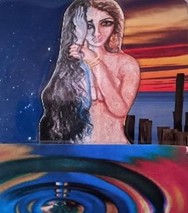
An invitation:
to courage, creativity, authenticity, healing; to soulful honesty;
to allowing the sacred to take form through our hands, voices, and choices.
Her presence in my life has reshaped my understanding of art, spirituality, and the Divine Feminine. Painting her many faces has become not just a creative act but a spiritual pilgrimage into Mystery itself.
A Final Invitation
Wherever you find yourself—male or female—on the edge of something new or lost in an
“awkward phase” of becoming, Mary Magdalene reminds us that transformation often begins
with a simple, courageous yes.
A yes to surrendering. A yes to healing.
A yes to creativity.
A yes to Mystery.
A yes to the Divine Feminine rising within.
Neither Mary knew where their yes would lead—the joy, love, pain, sorrow, and miracles. These Divine Feminine archetypes teach us to say yes—not because we know where the path leads, but because we trust the One who calls.
The Divine is rarely found in certainty.
She is found in the quiet, trembling courage of stepping into the unknown— surrendering to the Mystery
and discovering that Love meets us there, every time.


Comments